


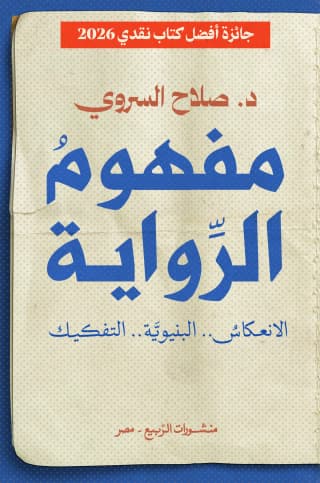
The Concept of the Novel
By Salah El-SarwyPublished by Al-Rabie Publications
The academic critic and great thinker Dr. Salah al-Sarawy presents to us and to all readers and writers his latest important studies on the art of the novel and novelistic writing, and on the analysis and criticism of the novel and its major schools.. The concept of the novel: "Reflection.. Structuralism.. Deconstruction"
DeliveryDepends on the shipping method PaymentSeveral ways to pay Safe checkoutYour details are protected
- Coming soonReaders rating
- Coming soonPublished
- Coming soonPages
- 1Author's books here
About the book
The academic critic and great thinker Dr. Salah al-Sarawy presents to us and to all readers and writers his latest important studies on the art of the novel and novelistic writing, and on the analysis and criticism of the novel and its major schools.. The concept of the novel: "Reflection.. Structuralism.. Deconstruction"
...
It can be said that most trends of contemporary criticism sprang from two main directions: social criticism and structural criticism. Yet several critical trends, previously unknown, arose with the emergence of postmodern philosophies, such as deconstructive criticism, cultural criticism, postcolonial criticism, feminist criticism, etc., all of which made important additions to literary critical theory in general and the theory of novel criticism in particular. I singled out the novel for mention because of the exceptional status it has held since the end of the twentieth century in terms of spread and breadth of readership, so much so that some critics considered that era the "age of the novel". These theoretical contributions to literary criticism had a great role and a profound effect on the movement of literary criticism, forming tributaries that cannot be ignored.
I used a comparative critical method, presenting the conceptions of each trend separately, linking and analysing them, trying to highlight the context that brings together the main ideas on which each trend rests, as well as the central propositions that bring out those ideas, and then the applied procedures that translate those propositions and ideas into practice, thus comparing these conceptions, in their integrated framework, with the other trend.
The aim was to build a fully formed conception of each one's view of the concepts and constituent elements of the novelistic literature.
The concept of the novel.
The novelistic character.
Methods of novelistic narration.
Book details
- Authors
- Salah El-Sarwy
- Pages
- Coming soon
- Format
- Paperback
- Language
- Arabic
- Publisher
- Al-Rabie Publications
- Category
- Studies & Criticism
- ISBN
- Coming soon
- Reads
- Coming soon
- Share
Reader reviews
Be the first to review this book
Your opinion helps other readers choose.